Electrical Duct Bank and Substation
Johns Hopkins University will install a new electrical duct bank from BGE’s substation on 23rd Street, north along Howard Street, to JHU’s campus on W. 31st Street, and will build a new substation adjacent to the Wyman 1 building. The duct bank and substation will supply electricity to both existing and new buildings on the Homewood campus to help meet JHU’s sustainability goals, as well as state electrification requirements.
Work will occur phases (in one to three block increments) on weekdays from 9 a.m. to 3 p.m. and there will be no interruption to traffic or parking during rush hour. We will schedule work to minimize disruption for local businesses, and we are working to identify parking alternatives for neighbors and businesses.
Project and Construction Information
A duct bank is an underground cable management system, often cast in concrete. It keeps wires & cables safe from environmental elements. Miles of duct banks exist below city streets. A substation is an electricity regulator that safely “transforms” high voltage electricity service to appropriate voltage for building operations.
When the new substation is complete, the existing substation in the Wyman 3 building will be decommissioned and demolished.
The duct bank and substation work will support campus electrification, decreasing greenhouse gas pollution and reducing reliance on fossil fuels. In 2002, Maryland codified the Maryland’s Climate Solutions Now Act, which established Building Energy Performance Standards requiring the phase-out of fossil fuels and building electrification to meet the state’s target of a 60% reduction in greenhouse gas emissions by 2031 and net-zero emissions by 2045.
The law applies to the majority of buildings over 35,000 square feet across the entire state (e.g. grocery stores, apartment buildings, office buildings), including most buildings at JHU. Over the next twenty-years thousands of buildings across the state will replace gas-fired equipment with electrical equipment, to reduce pollution, increase renewable power, and mitigate Maryland’s impact on climate change.
Most buildings across JHU, including at the Homewood Campus, will need to convert from natural gas to electrified heating in the coming years to meet JHU’s sustainability goals and MD’s state requirements.
JHU is committed to being a leader in the state’s drive to reach net zero greenhouse gas emissions by 2040, five years before the state requirements. Our Climate Action and Sustainability Plan establishes commitments to:
- Procure 100% of purchased electricity from renewable sources by 2030—building on JHU’s existing Solar Agreement
- Increase our waste stream diversion from landfill and incineration to 50% by 2030
- Purchase all new light-duty and passenger vehicles as electric by 2030
- Electrify our heavy-duty vehicles, as seen in the recent rollout of five electric buses for our Homewood-Peabody-JHMI route, the busiest route on campus.
JHU also established new High Performance and Healthy Building Requirements for all capital projects as part of the plan’s framework. These requirements integrate sustainability into projects with a holistic emphasis on energy, resilience, water, landscape, materials, and health and well-being.
The existing substation, located on the Wyman parcel in Wyman 3, is almost 40 years old and outdated based on the university’s current and anticipated needs. This will be the first time in 30 years JHU has brought new electrical lines to the Homewood campus. This infrastructure will support multiple new and existing buildings on the Homewood campus – and is necessary to meet Maryland’s electrification requirements and JHU’s published sustainability goals as outlined above.
Work is anticipated to begin in Spring 2026 and will take 12-14 months – with only one or two blocks partially closed at any time, and two-way traffic on Howard St. open as usual during rush hour.
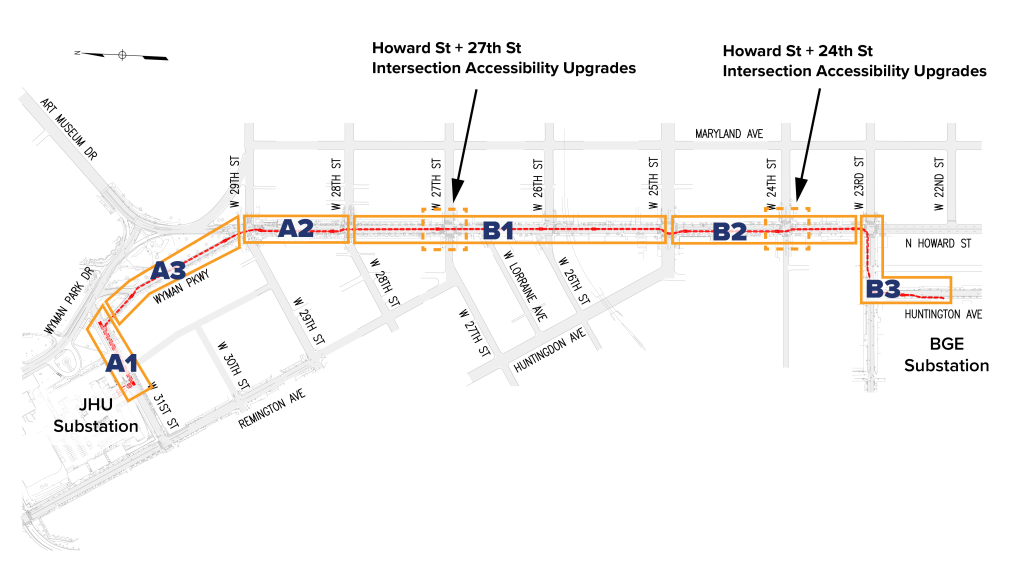
Work will be completed in segments, as shown above. Construction will occur on weekdays from 9 a.m. to 3 p.m. Flaggers and signage will be in place to direct traffic through the work zone. Parking restrictions are only in effect during work hours. When work is done for the day, steel plates will be placed on top of the road to allow for regular traffic patterns and parking.
JHU will proactively reach out to residential and commercial property owners on the affected blocks in advance of the start of work on each phase, and we are working to identify parking alternatives.
Duct Bank and Wiring
- The duct bank, wiring, repaving, and sidewalk upgrades will be completed entirely at JHU’s expense – with no cost to the city or BGE.
- When complete, the duct bank will be owned by Baltimore City.
- The switch gear and wire within the conduit will be transferred to BGE.
- Electrical Grid Capacity
- The project will move a portion of the Homewood campus off of the local electrical grid, freeing up additional capacity for neighboring homes and businesses.
City Streets and Sidewalks
- Johns Hopkins will pay for all of the construction, fully repaving the affected work areas, including repaving Wyman Parkway from curb to curb.
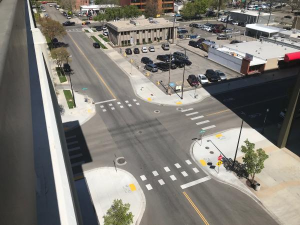
- When work is complete, JHU will install ADA compliant curbs, sidewalk bump outs, and repainted crosswalk stripes at 27th St. & Howard St. and 24th St. & Howard St.
Community Meeting | March 2, 2026
Intersection upgrades on 24th Street & Howard Street and 27th & Howard Street will look similar to the image below. Please note that this image is not a rendering of JHU’s work, but is intended to give a general idea of the look and feel of the intersection upgrades for ADA compliance and pedestrian safety.